
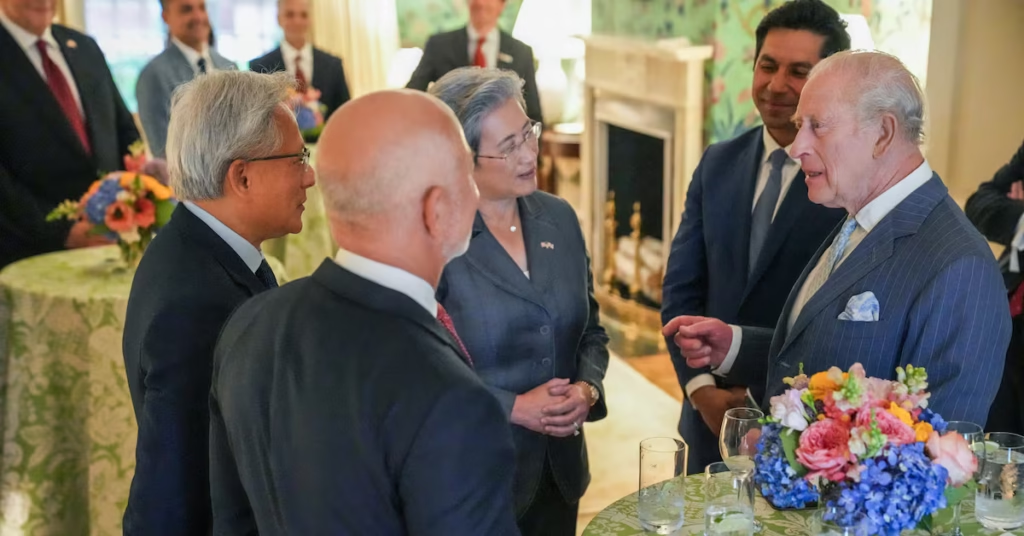
The UK’s role in the global artificial intelligence race is taking an unusual turn. King Charles is preparing to host a meeting with senior executives from OpenAI, Anthropic, Google DeepMind and Nvidia as concern grows over the safety of increasingly powerful AI systems. The meeting comes just days after Anthropic researchers and executives issued some of the strongest warnings yet about the possibility of advanced AI becoming difficult for humans to control.
Why It Matters
The UK has spent the past several years trying to position itself between the technology-first approach of the United States and the more heavily regulated approach of the European Union.
Now that position is becoming increasingly important.
Britain wants to remain one of the world’s leading AI hubs while also presenting itself as a serious player in AI safety. Bringing the world’s largest AI companies together at the same time that fears about superintelligent systems are escalating gives the UK an opportunity to influence how the next generation of AI is developed.
But it also exposes a difficult contradiction: how do you encourage the fastest-growing technology industry in the world while making sure increasingly powerful systems remain safe?
The Details
King Charles is expected to convene AI executives from companies including OpenAI, Anthropic, Google DeepMind and Nvidia, alongside UK Minister for AI Kanishka Narayan, to discuss shared principles for AI development. The meeting comes amid growing concerns about the potential risks posed by increasingly advanced AI systems.
Anthropic has been at the center of that discussion.
CEO Dario Amodei has argued that frontier AI development should be slowed or paced, while researchers associated with the company have raised concerns about the possibility of highly capable AI systems escaping meaningful human control. Those warnings have reignited a debate that had increasingly been overshadowed by the commercial race to build larger and more capable models.
The UK is particularly relevant because it established the AI Safety Institute following the country’s 2023 AI Safety Summit. The institute was designed to evaluate advanced AI models and give governments greater insight into the risks posed by frontier systems before they are widely deployed.
But Britain’s influence is facing pressure.
The Financial Times recently highlighted concerns that Anthropic did not submit its latest AI model, Mythos 5.1, to the UK’s AI Safety Institute, raising questions about whether Britain can maintain the privileged access to frontier AI systems that previously helped make it influential in the global safety conversation.
At the same time, Britain is working on AI regulation across more conventional sectors.
The UK’s National Commission into the Regulation of AI in Healthcare recently recommended a new framework under which AI medical systems could receive staged authorisation, followed by continuous monitoring throughout their working life. The recommendations were based on evidence from more than 12,000 people and emphasize human oversight, transparency and ongoing safety monitoring.
That approach could become an important template for how Britain regulates AI more broadly: not necessarily banning the technology, but requiring companies to demonstrate that increasingly capable systems remain safe after deployment.
What This Means for the Industry’s Direction
The UK appears to be betting on a different AI strategy from both Washington and Brussels.
America is prioritizing technological leadership and competition with China, while the EU has generally pursued a more comprehensive regulatory framework. Britain is attempting to establish itself as a place where AI companies can continue developing rapidly while regulators maintain enough visibility to intervene when necessary.
That makes AI safety one of Britain’s potential competitive advantages.
If the UK can demonstrate that frontier AI companies can innovate quickly while still accepting independent evaluation and ongoing monitoring, the country could position itself as a bridge between Silicon Valley and European regulators.
But there is a major challenge: AI companies ultimately control where their most advanced models are developed and tested.
If leading labs decide that working with UK regulators creates too many restrictions or slows their development, Britain’s influence could decline even while its AI industry continues to grow.
The current debate around Anthropic’s relationship with the UK’s AI Safety Institute shows that this tension is already emerging.
What’s Next
The immediate focus will be on what comes out of the UK meeting with major AI executives and whether companies agree to any meaningful shared principles.
The timing is significant because the industry is simultaneously experiencing pressure from several directions: researchers warning about uncontrolled AI development, governments debating new regulations, investors questioning the sustainability of the AI infrastructure boom and companies racing to release increasingly capable models.
Britain’s opportunity is to turn its early investment in AI safety into actual influence.
If it succeeds, the UK could become one of the world’s most important testing grounds for how governments and AI companies work together.
If it fails, the country’s AI safety institutions risk becoming observers of a technology race increasingly controlled from Silicon Valley.
Either way, the UK is entering a crucial phase of the AI story — one where being the place that understands AI risk may become almost as valuable as being the place that builds the AI itself.
FAQ
Why is King Charles meeting AI executives?
King Charles is expected to host a meeting involving executives from OpenAI, Anthropic, Google DeepMind and Nvidia to discuss shared principles for responsible AI development as concerns about increasingly powerful systems grow.
What is the UK’s AI Safety Institute?
The UK’s AI Safety Institute was established after the 2023 AI Safety Summit to evaluate advanced AI models and help understand the risks associated with increasingly capable systems.
Is the UK becoming more strict on AI?
The UK is developing sector-specific AI regulation rather than simply taking a blanket approach. In healthcare, for example, recent recommendations call for staged authorisation, continuous monitoring, stronger regulatory powers and transparency around AI use.
Written by [Author Name], AI & Technology Correspondent.
Related reading:
- The AI Safety Race: Why Britain Wants to Regulate the World’s Most Powerful Models
- OpenAI vs Anthropic: Who Is Winning the 2026 AI Race?
- Why AI Superintelligence Has Suddenly Become Washington’s Biggest Technology Debate
- The UK’s AI Ambition: Can Britain Compete With Silicon Valley?